Free MCAT study note
The Seven Enzyme Classes (EC 1 to 7) With Examples and Traps
Enzymes are named by what they do, and the Enzyme Commission (EC) system sorts every enzyme into a numbered class by the type of reaction it catalyzes. The MCAT does not ask you to memorize EC numbers, but it does ask you to look at a reaction, or at a name, and say which class it belongs to. The skill is recognizing the reaction pattern.
How EC numbers work
Each enzyme gets a four-part number: EC a.b.c.d. The first number is the class (what you need for the exam). The second and third narrow it down by the type of bond or group involved, and the fourth is a serial number. Lactate dehydrogenase is EC 1.1.1.27: class 1, an oxidoreductase acting on a CH-OH group with NAD+ or NADP+ as the acceptor.
For a long time there were six classes. A seventh, the translocases, was added in 2018.
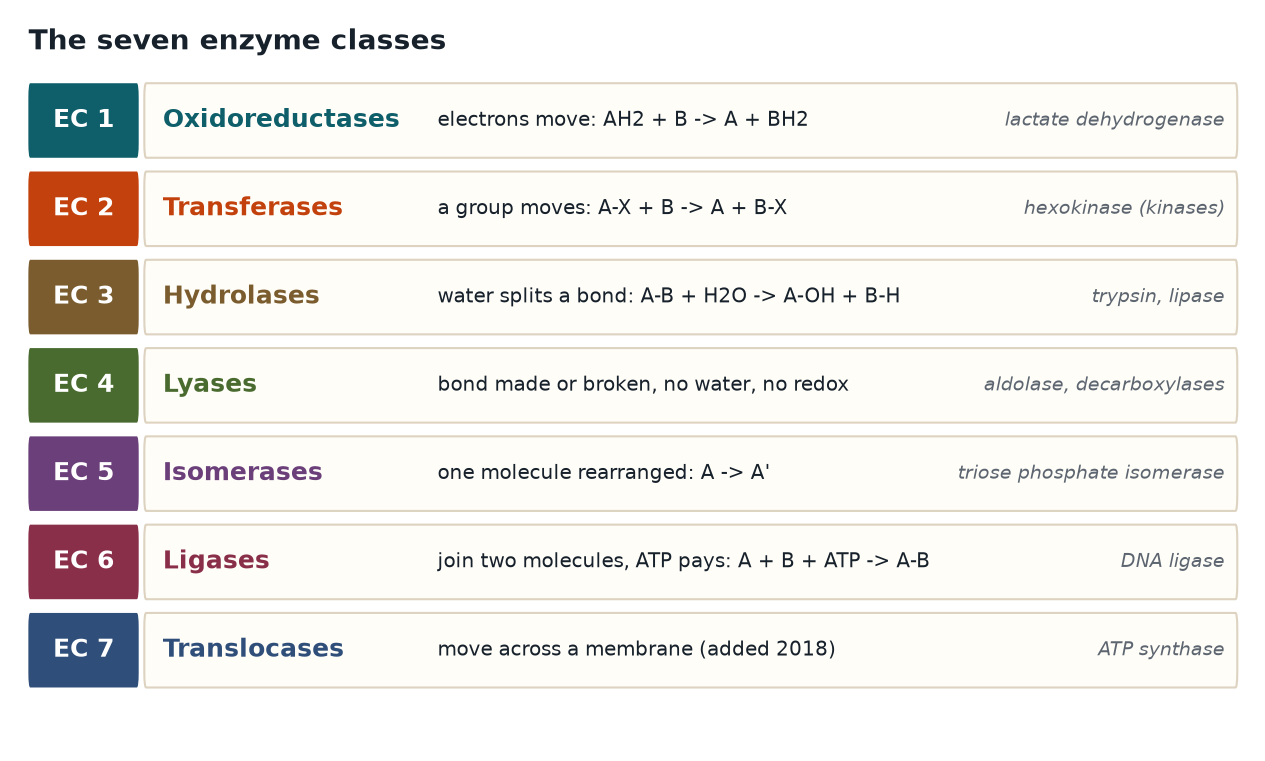
Here is a memory line for the order: Our Team Helps Learners Identify Lots of Types, standing for oxidoreductases, transferases, hydrolases, lyases, isomerases, ligases, translocases.
EC 1: oxidoreductases
Reaction: transfer of electrons (or hydrogen atoms) from one molecule to another. One substrate is oxidized, and another is reduced.
Names often include dehydrogenase, oxidase, reductase, or oxygenase. They commonly use cofactors that carry electrons, such as NAD+/NADH, NADP+/NADPH, and FAD/FADH2.
Examples: lactate dehydrogenase (pyruvate and NADH to lactate and NAD+), alcohol dehydrogenase, glyceraldehyde-3-phosphate dehydrogenase, succinate dehydrogenase.
EC 2: transferases
Reaction: transfer of a functional group (phosphate, amino, methyl, acyl, glycosyl) from a donor to an acceptor.
Kinase is the signature name: a kinase moves a phosphate group from ATP to a substrate. Aminotransferases (transaminases) move an amino group, and methyltransferases move a methyl group.
Examples: hexokinase (EC 2.7.1.1, glucose + ATP to glucose-6-phosphate + ADP), alanine aminotransferase (ALT), protein kinase A, and glycogen phosphorylase.
EC 3: hydrolases
Reaction: cleavage of a bond by adding water.
AB + H2O gives A-OH + B-H. Hydrolases are the digestive and degradative enzymes.
Examples: proteases such as trypsin and chymotrypsin (peptide bonds), lipases (ester bonds in fats), phosphatases (remove phosphate groups), nucleases, amylase, and soluble ATPases that split ATP using water.
EC 4: lyases
Reaction: cleavage or formation of a bond by means other than hydrolysis or oxidation, usually creating or removing a double bond or ring. Water is not used to split the bond, and electrons are not transferred. Lyases that handle water (hydratases) add or remove it across a double bond rather than cleaving a bond with it.
Lyases typically work in the breaking direction, but the same enzyme in the reverse direction joins two molecules by adding across a double bond.
Examples: aldolase (splits fructose-1,6-bisphosphate into two three-carbon sugar phosphates), pyruvate decarboxylase (removes CO2), fumarase (adds water across fumarate's double bond to make malate), and carbonic anhydrase (CO2 + H2O to bicarbonate and a proton).
Names containing decarboxylase, dehydratase, aldolase, or hydratase are good lyase clues.
EC 5: isomerases
Reaction: rearrangement within a single molecule, producing an isomer.
Subtypes you may see are racemases and epimerases (change stereochemistry at one center), mutases (move a group to a different position on the same molecule), and cis-trans isomerases.
Examples: triose phosphate isomerase, phosphoglucose isomerase, phosphoglycerate mutase, and alanine racemase.
EC 6: ligases
Reaction: joining two molecules together, coupled to the hydrolysis of ATP (or another nucleoside triphosphate).
The energy cost is the identifying feature. Bonds form with energy from ATP, so the reaction is driven forward.
Examples: DNA ligase (seals nicks in DNA), aminoacyl-tRNA synthetases (attach an amino acid to its tRNA), and pyruvate carboxylase (adds CO2 to pyruvate to make oxaloacetate, using ATP).
EC 7: translocases
Reaction: movement of ions or molecules across a membrane, or their separation within a membrane.
These enzymes catalyze transport coupled to a chemical reaction such as ATP hydrolysis or electron transfer. The class was created in 2018 to hold enzymes that were previously filed awkwardly under other classes.
Examples: ATP synthase (EC 7.1.2.2) uses the proton gradient to make ATP, and the proton-pumping NADH:ubiquinone oxidoreductase of the electron transport chain is also in this class. The sodium-potassium ATPase is classified here as well.
Older textbooks, and many exam passages, still list these under oxidoreductases or hydrolases, so use the context you are given.
Name clues at a glance
| If the name says | Likely class |
|---|---|
| dehydrogenase, oxidase, reductase | 1, oxidoreductase |
| kinase, transaminase, methyltransferase | 2, transferase |
| -ase on a substrate that gets broken down with water (protease, lipase, phosphatase) | 3, hydrolase |
| decarboxylase, dehydratase, aldolase, lyase | 4, lyase |
| isomerase, mutase, racemase, epimerase | 5, isomerase |
| ligase, carboxylase using ATP, synthetase | 6, ligase |
| ATP synthase, ion-pumping ATPase | 7, translocase |
Traps that cost points
Phosphorylase vs. phosphatase vs. kinase
- A kinase transfers a phosphate from ATP to a molecule (transferase).
- A phosphatase removes a phosphate using water (hydrolase).
- A phosphorylase adds an inorganic phosphate to break a bond, as glycogen phosphorylase does when it cleaves glucose units off glycogen with inorganic phosphate rather than water. It is a transferase, and the product is glucose-1-phosphate.
Synthase vs. synthetase
The classic rule: a synthetase uses ATP to join molecules (a ligase), while a synthase does not need ATP. This rule is a useful default but not perfect. Naming is historical, and the official class depends on the reaction. Citrate synthase is a good example: it forms a carbon-carbon bond without consuming ATP, and it is currently listed as a transferase (EC 2.3.3.1), not as a lyase. Use the rule when the passage gives only a name, and defer to the reaction when it gives one.
Dehydrogenase vs. dehydratase
Dehydrogenase removes hydrogen (electrons are transferred, so class 1). Dehydratase removes water without a net redox change (class 4).
Hydrolase vs. lyase
Both break bonds. The test: does water get added to split the bond? If yes, hydrolase. If a double bond is formed or an elimination occurs without water as a reactant, lyase.
Ligase vs. transferase
Both can use ATP. A ligase forms a new bond between two molecules and the energy comes from ATP hydrolysis. A kinase uses ATP as a phosphate donor, so the product carries the phosphate group, and it is a transferase.
Reversibility
An enzyme speeds up a reaction in both directions, since it does not change the equilibrium. Classification is by the reaction as written in the official listing. An aldolase works in glycolysis to cleave and in gluconeogenesis to join, yet stays a lyase either way.
A fast decision procedure
- Are electrons moving between molecules? Oxidoreductase.
- Is a group moving from one molecule to another? Transferase.
- Is water splitting a bond? Hydrolase.
- Is a double bond forming or breaking with no water used and no redox? Lyase.
- Is it one molecule changing shape? Isomerase.
- Are two molecules joined with ATP paying for it? Ligase.
- Is something being moved across a membrane? Translocase.
One-minute recap
The seven classes are oxidoreductases (redox), transferases (move a group), hydrolases (cleave with water), lyases (cleave or form double bonds without water or redox), isomerases (rearrange one molecule), ligases (join with ATP), and translocases (move across membranes). Learn the reaction pattern first and the name clues second, and double-check the odd ones: phosphorylase, synthase vs. synthetase, and dehydratase.
Check yourself: 5-question mini-quiz
1. Alanine aminotransferase moves an amino group from alanine to alpha-ketoglutarate. Which EC class is it?
Class 2, a transferase. It transfers a functional group (the amino group) from one molecule to another.
2. An enzyme cleaves a peptide bond by adding water across it. Name its class.
Class 3, hydrolase. Proteases such as trypsin are the standard example.
3. What distinguishes a ligase from a lyase?
A ligase joins two molecules and the reaction is coupled to ATP hydrolysis, which pays for the bond. A lyase breaks or forms bonds (often creating or removing a double bond) without hydrolysis or redox chemistry and without ATP coupling.
4. Glycogen phosphorylase cleaves glucose from glycogen using inorganic phosphate. Why is it a transferase rather than a hydrolase?
The bond is split by phosphate rather than by water, so it is a phosphorolysis. Phosphate is transferred onto the glucose unit, giving glucose-1-phosphate.
5. Which class was added most recently, and what does it do?
Translocases (EC 7), added in 2018. They catalyze movement of ions or molecules across membranes, coupled to a reaction such as ATP hydrolysis or electron transfer.